Friday, 9 November 2012

Tales of a Nairobi Researcher


Yesterday was the pièce de résistance of my research so far - an interview with Kenya's Commissioner of Refugee Affairs.  The Commissioner is the Head of the Department of Refugee Affairs and reports to the Minister for Immigration, so he is essentially the top guy for refugee management in the country.  It was my third trip to the Department of Refugee Affairs - my first was for an interview with one of their Protection Officers, whose role it is to liaise with UNHCR on individual cases, visit local prisons and police stations to see if 'illegal immigrants' detained there might be asylum seekers, and assist with the government's registration and issuing of ID cards to refugees approved by UNHCR.  The second visit to the Department was to deliver my letter of request for a meeting with the Commissioner.  The Protection Officer I first met with advised me that this would be better than emailing or phoning.  So I went and found the fanciest print shop and paper I could in Nairobi, plastered my letter with as many official looking university logos I could and hand delivered my letter to the office.  And voilà, it worked!

The Department of Refugee Affairs is housed in a castle.  While I suspect it was never really a castle - more likely the play thing of some colonial official with too much money - the fortified appearance, thick stone walls and turrets leave you in doubt as to what this was intended to be.  My regular visits there have made me the subject of some interest to the staff - including the receptionist, who wears a long blue trench coat with 'Refugees are real people' inscribed on the back, and the guards at the front gate, one of whom seems always to want me to buy her tea (I'm not sure from where) and the other of whom wants me to take him to Australia!  It's interesting stuff this research business, so here is a little snapshot of just a few of the interviews I have done in Kenya.

  1. Commissioner of Refugee Affairs, Government of Kenya.  Despite the official hoops I had to jump through to secure the interview, and the imposing nature of his office (think white leather padded walls), the man himself was very relaxed, candid and a great person to talk to.  His perspective on refugee protection in Kenya was extremely interesting and very different from most of what I have heard so far.  In particular, he is concerned about the impact that the monolithic humanitarian industry in Kenya has on its refugee burden - while he certainly acknowledges that many humanitarian agencies provide essential and life-saving assistance to refugees, the appeal they hold for people in neighbouring countries, combined with their interest in sustaining their own business, perpetuates the very refugee 'problem' they purport to solve.
  2. Head of Refugee Status Determination, UNHCR Nairobi.  UNHCR conducts refugee status determination in Nairobi as well is in Kakuma and Dadaab Refugee Camps.  Here in Nairobi, the UNHCR office has just moved.  When I visited they were still waiting for hot water and a functioning printer.  Despite this, the head of RSD here in Nairobi has been one of the most open and helpful people I have met with so far.  Not only was she very frank about her own work and that of her team, but she even arranged for me to observe an interview with an asylum applicant from the Democratic Republic of Congo - in Nairobi with seven of her eight children - and allowed me to take copies of numerous UNHCR documents that I have not been able to obtain elsewhere.
  3. Legal Intern, Kituo Cha Sheria.  As often seems to happen with NGOs here in Kenya, the request for an interview from a researcher gets bumped on to the person with the least responsibilities and (supposedly) the most time.  Having worked in NGOs, where staff do not have enough time to do their jobs let alone talk about them to researchers, I have total sympathy for this approach.  As a researcher, I think sometimes it works in my favour.  Though interns usually have less experience than more senior members of staff, the experience they do have is often fresher, giving them a more critical eye and an eagerness to talk about it.  The interview also gives them a perhaps rare opportunity to be the expert in something, so they are more than forthcoming with information and willing to share stories, perspectives and useful documents.  Possibly the most notable thing about Kituo Cha Sheria (which means Centre for Justice) was its location.  Housed in a building in Eastleigh - a predominantly Somali area - my driver George had warned me not to wear open-toed shoes.  When we got there, I found Eastleigh positively thriving with street-side business, dealing and life - this was one of the busiest and most chaotic places I have been, and that includes India!  The problem, however, is that the 'street' ranges between mud, swamp and river.  When the traffic got too chaotic (5 cars side-by-side trying to forge their way down a road which is one lane in either direction) George pulled up on the side-walk and suggested we walk.  And while I appreciated George's shoe advice, I really think that unless I had been wearing gumboots it wouldn't have made a difference at all. 
  4. Justice of the High Court of Kenya and the East African Court of Justice.  This is the interview that gave me the most attire-related anxiety, owing to a Judge suggesting that we meet in one of Nairobi's poshest hotels.  A fascinating man and one who has been involved in some high profile cases here in Kenya - including a Constitutional dispute about the date of the elections which, understandably given the election-related violence of 2007-8, was the subject of considerable attention.  What impressed me most about this interview was the keen interest that the Kenya judiciary (at least some of them) has in refugee protection matters, despite them having very little jurisdiction of such matters at present.  With the assistance of UNHCR and others, they have developed a refugee law training program for judicial officers, conducting regular training sessions around the country.  While the implementation of the program still has a way to go - asylum seekers and refugees are still notoriously being arrested and convicted of unlawful presence, despite their right to be in the country - the willingness to engage with refugee protection and implement improvements was evident in both my interview with this High Court judge and in the 100-page refugee law training manual he shared with me afterwards.
On Monday I will travel to Kakuma Refugee Camp, in the north of Kenya and near the border with South Sudan.  I had initially intended to also go to Dadaab - Kenya's other main refugee camp and the largest in the world.  But owing to particularly bad security in the Somali border region at present and the fact the registration and refugee status determination is currently suspended, I will confine my visit to Kakuma.  I will spend the week in Kakuma.  It will be my last week of 'field research' proper and no doubt will prove to be one of the most interesting.  I really don't know what to expect - like the Kibera slums in Nairobi, refugee camps are mostly painted as sprawling masses of UNHCR tents, poverty, malnourishment and enforced passivity.  However more than one person I have spoken with so far has told me that Kakuma is a place where 'a lot is going on'.  I guess I'll find out on Monday.

Castle House - currently home to the Department of Refugee Affairs 
Me at the Department of Refugee Affairs.  Photos are usually forbidden at official sites,
but I must have looked suitably awestruck and innocent that one of the guards agreed
for me to pose in front of the building.  (Or maybe this was part of his campaign
to get me to marry him and take him back to Sydney....)
We had persevered with Eastleigh traffic for quite some time (including two phone
calls to the office of Kituo Cha Sheria to give an updated ETA).  But after we had been
faced this sight for about 15 minutes with no movement, we decided to walk. 
A birds eye view of Eastleigh 
Refugee Consortium of Kenya.  Along with Kituo Cha Sheria the other main refugee law NGO
in Nairobi.  Like many other NGOs, who have been pushed out of the city centre by rising
 rents, the organisation's offices are now in a former residential home in the suburbs.
A view from the back of the lecture room where I delivered my presentation
on research methods on Day 1 in Nairobi.  Not exactly interview-related
but still relevant to my research so I thought I'd throw it in!

Thursday, 1 November 2012

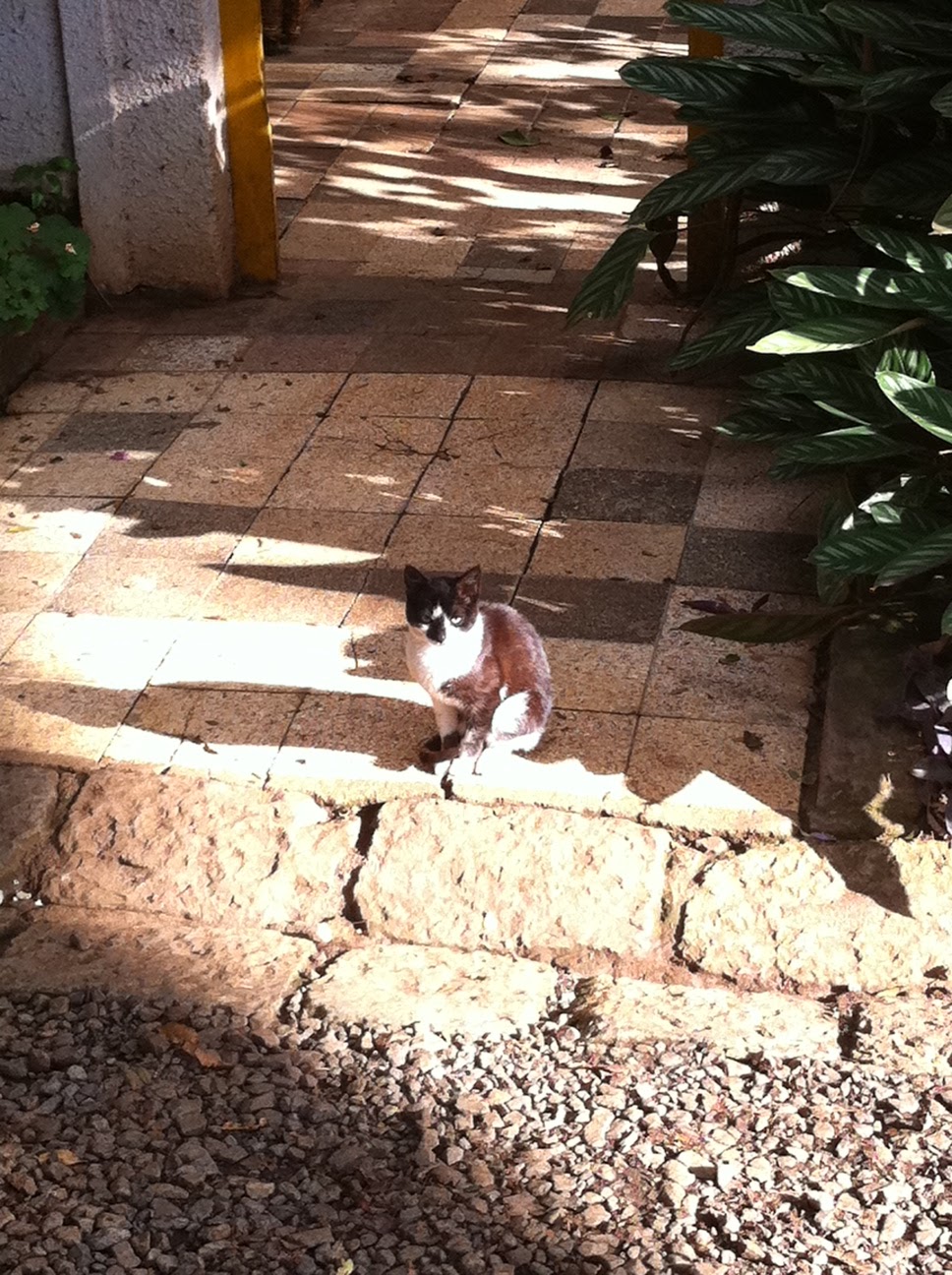
Bandit


This is my little friend at the Nairobi Guesthouse.  One of my fellow housemates, Anneke, has named him Bandit.  Others here think that he might have previously had a different name - like Button - but I definitely think Bandit suits him much better.  He has way too much attitude for a cutesy name like Button...


Bandit is one of two kittens that have claimed territory over the Guesthouse.  Judging by the greater size and strength of the other one - Bandit is tiny - my guess is that Bandit fell to number 2 in the pecking order.  But to make up for it, he has wormed his way in with the humans.  I need only sit on the front porch with food for a few seconds and Bandit will faithfully appear and wait patiently for his share.  He approaches by stalking - crouched, very low and very slow - so that the first time I thought  there was either a mouse nearby that I hadn't noticed, or he was about to pounce on my bowl of muesli!  Bandit only eats human food.  Beans, carrots, pasta - yes please.  Tuna, beef - bring it on!  Cat food? Sniff...

Bandit won't let you touch him, and he won't come in the house (Anneke and I have secretly tried to encourage him in).  But for a cat that plays so hard to get, he is very demanding!  And if I am late with his tuna, he'll sit at the front door eyeballing me down the hall in the kitchen.  Bandit will eat pasta from my hand, sort of.  If I dangle it from my finger, he'll swipe it off with his paw.  He employs that same strategy when I serve him tuna with a fork.  I have to make sure I get it out of the can and on to the ground quick smart, if I dilly dally on the way down Bandit will take a swipe and tuna goes everywhere!

Usually I would worry about what will happen to a stray animal I'm feeding when I go.  But in this case I'm not too worried.  The night guards feed Bandit their chapatis, other housemates feed him their pizza.  Even my driver, George, knows Bandit - 'that cat will eat anything!'  Well, yes, except cat food. Something tells me that Bandit has both the charm and the smarts to make it just fine.


Wednesday, 31 October 2012

Nairobi Part 2


Week 3 in Nairobi and I still haven’t set foot in the heart of the city.  Nor have I been to the Museum.  I console myself with the fact that the CBD is rarely the most interesting part of any city – the quick drive I have done through the centre of ‘town’, as it is called, revealed the kinds of tall buildings, busy roads and even glittering casino one might expect in most cities.  Not that I don’t want to explore further - but I have just been so busy exploring the other parts of Nairobi that I haven’t made it there yet!

Most of my time so far has been spent walking or driving between interviews, of which I have had many (but more on that later).  One of the best things about visiting lawyers, NGO workers, UNHCR and government officials is that their offices – or alternatively, the cafes they suggest we meet in – are all over Nairobi.  I walk when I can – this is still a relative novelty after being in Jo’burg.  Nairobi definitely feels like a calmer safer to walk around in, though I would still never go out at night.  While security abounds, I am told this is not due to general crime; rather it is largely a response to the few terrorist bombings carried out in the city by Al-Shabab in the last year or so.  Perhaps I have been in Africa too long, but this actually makes me feel safer.  When it gets too hot I buy fruit salad from a roadside stall and put up my umbrella as sun protection.  When I get too dusty and sweaty I look for a shopping centre with a Java House or Dormans café to recuperate.  And when the distances are longer, or I am not quite sure where I am going, I travel with George, my taxi driver.

The streets in Nairobi’s suburbs are lovely.  At the risk of repeating myself, they are so green!  Huge old trees, grass, vines, hedges and brightly coloured flowers everywhere.  Many gardens still display a very definitely British sensibility – the house just up the road from where I am staying could be straight out of the Cotswolds.  But a lot the greenery is wild and sprawling, and it’s often hard to believe you are in a city at all.  The state of the roads themselves has the same effect.  Many look like the have not been attended to for decades, and the extent of the potholes, some of them several feet deep, makes driving in a straight line nearly impossible.

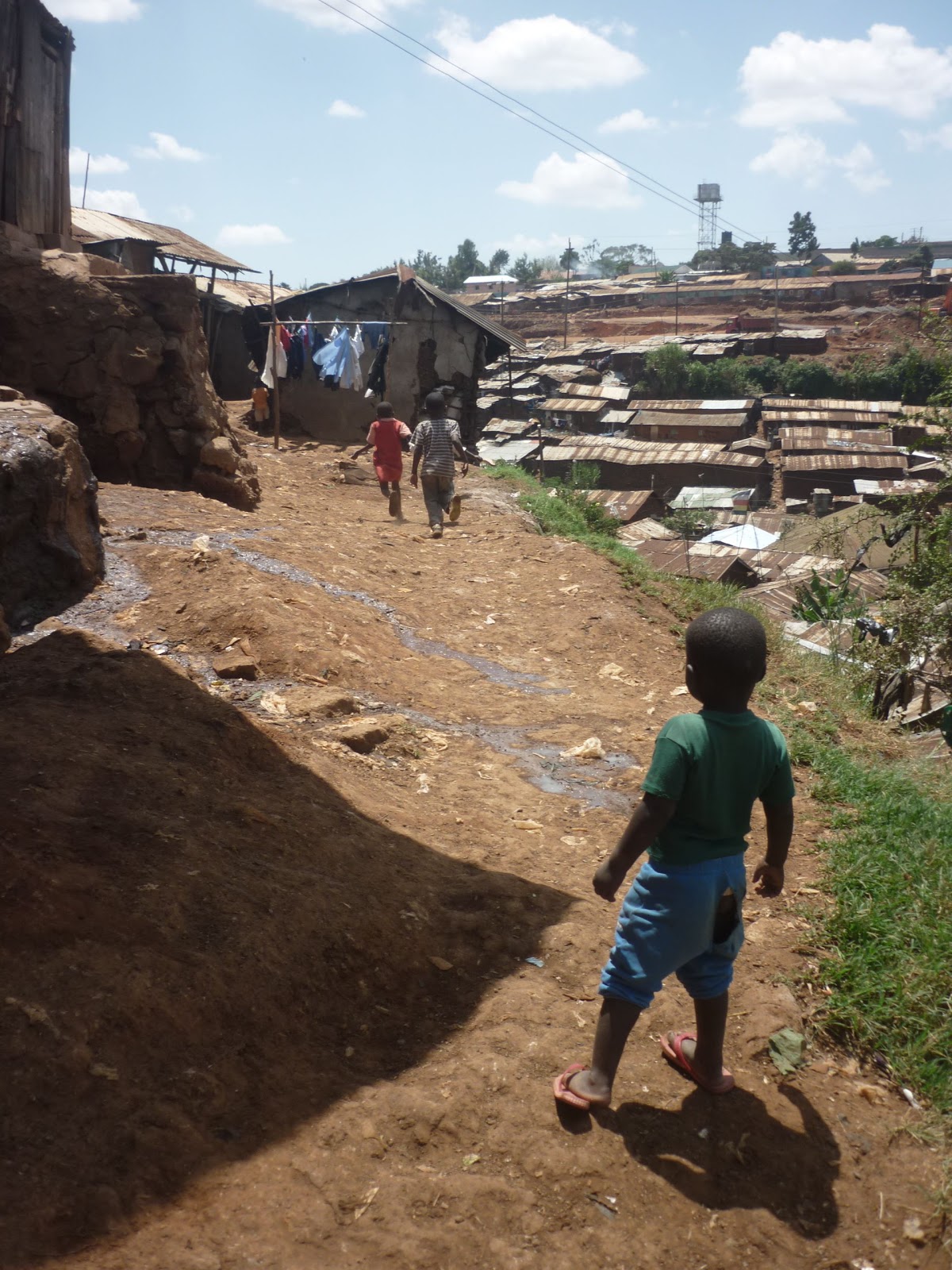
Last weekend I venture a little further afield, with a visit to Kibera.  Even if you have never heard of Kibera you will probably feel like you have seen it a hundred times.  It is the quintessential image of poor Africa – an inner city slum full of dust, rubbish, open sewerage, barefoot children, makeshift homes and a few animals.  As well as being the largest slum in Africa, it is apparently the most studied, owing to the fact that it is so close to the CBD and UN-HABITAT’s office is nearby.  Many of the homes here have neither running water nor sewerage and unemployment is apparently somewhere around 40%.

On the one hand I think it is important to acknowledge and address the level of poverty that many people in Africa live in.  In fact, getting a better understanding of what life is like under these circumstances is one of the main reasons I have wanted to come here for so long.  I’ve always believed (or hoped) that if everyone in the world was forced to come face to face with these realities they would not be allowed to continue.  But having now spent some time here and having visited Kibera, I feel less sure that perpetuating the image of the poor, helpless Africa is very helpful at all.

Certainly Kibera is a place of extreme poverty – there are single mothers there who spend their days offering to wash other women’s clothes for a sum of about 100 shillings – less than a dollar.  And there are children who will catch and suffer from diseases that could be easily prevented or treated in better conditions.  But most of the people I saw during my visit were anything but passive victims of their surroundings.  Kibera is a hive of activity and a vibrant breeding ground for small businesses and other entrepreneurial activities.  Many of the shanty-type homes in Kibera double as shopfronts, selling everything from homemade soaps to pre-paid mobile credit to chapatis.

Kibera is on the list of places to which both the Lonely Planet and Australian government advise against travel.  This is ironic – according to my guide Frankie (and verified with others I have spoken to since) Kibera is one of the safest places in Nairobi, due to the local community’s ‘people power’.  ‘People power’ is a slightly euphemistic term for describing the fact that anyone caught stealing in Kibera will be set upon by a group of locals and, more often than not, killed for their crime.   This is apparently a result of the community’s impatience and frustration with local police and justice mechanisms.  Unsurprisingly, it has vastly reduced the amount of crime, at least during the day.

The other thing that struck me about my visit to Kibera is the fact that so much of Nairobi is not like Kibera.  In many ways, it is a booming city.  There are good universities here, a growing economy and lots of development – those given the opportunity could really make a go of it.  In fact my guide Frankie grew up and still lives in Kibera.  He was sponsored by an NGO to attend school and is now studying towards an accounting degree at the University of Nairobi – he shows people around his home town as a part time job to help him through his studies.  No doubt, education is key.  That’s why on Friday I plan to return to Kibera and spend the day volunteering at one of the local primary schools.  I might just have to teach them how to sing Happy Birthday!


One of the lovely suburban roads where I spend my days walking.
Entrance to the British Institute of East Africa, my Nairobi home.
Bus stop in Karen, the suburb named after Karen Blixen (Out of Africa)
Tree signs are one of my favourite features of the African urban landscape. 
There is every kind of religion in Kenya - in the morning I wake alternatively
 to church bells and the call to prayer at the nearby mosque
Kibera - Africa's largest slum.  The apartments behind are being built as part of the
upgrade/development program, but Frankie explained to me that they are unaffordable for most
Kibera residents, costing about $30 a month (between 2 and 6 times the costs of rent in Kibera itself).
The railway line through Kibera is still used by passenger and freight trains. 
This is Modest, who works with women in Kibera to make
 jewellery and other handicrafts for sale at Pam's curio shop
Homemade soaps for sale - these soaps are made by people infected or affected by HIV/AIDS 
I now understand why everyone returns from Africa with photos of children - they love having
 their photo taken!  Kibera Tours, through whom I arranged my visit, have a quite strict photo
policy, only allowing photos at certain stops during the visit.  Frankie made an exception
in this case, after the kids begged for me to take their photos!
The kids love being photographed, but they love even
more seeing their images on the camera view screen afterwards.
I think this little fella saw himself as our mini security guide - here he is chasing off some of the bigger kids. 
The view from inside a Kibera home - the mzungu lady is an intriguing sight in Kibera.. 
Women doing their washing together at a community water source. 
Almost every second wall or fence in Kibera has an NGO's logo on it. There are
apparently over 800 NGOs working in this area, only some of the working well. 
The Bead Factory.  This factory buys cow, goat and camel bones from butchers and slaughterhouses and turns them into jewellery.  It's a remarkable use of limited resources, though the dust and smell of bones is a bit overwhelming!

It's not only the kids who love having their photo taken!
What would Workcover say about this.... The head of the factory proudly showed me the scars
on his hand, suggesting they are some kind of mark of achievement for workers.  I'm not so sure...
This worker is making little turtle shapes from the bone - you can see a pile forming on the floor.

And this is the end result! 
Toi Market - this market is all that separates Kibera from one of Nairobi's expensive, middle-class suburbs/
Toi Market 
Coal is sold here for about ten cents a bucket.  It will be used for heating and cooking.
I don't know about you, but this sign somehow just doesn't inspire confidence in me....
Most of the dogs I see or hear in Nairobi are guard dogs.  Judging by
this fella's wagging tail, he is not very good at his job.

The road home to my guesthouse at the end of the day...

Wednesday, 24 October 2012

Fashion in the field


Patrick (my brother, a journalist) loves conducting interviews.  He describes it as ‘a socially acceptable way of prying into other people’s lives’.  While I’m not sure that interviewing lawyers and government officials about international refugee law offers quite the same voyeuristic opportunities, it certainly does provide some interesting perspectives on the diversity of life and work in Africa.  From interviewing staff at Kenya’s largest refugee NGO – in a rundown old suburban house, with plywood screens for walls and electricity dropping in and out – to meeting with one of UNHCR’s regional representatives – in a shiny new megastructure in the lush green hills of Nairobi’s expensive northern outskirts, bound by retractable security barriers and landscaped gardens, and with the whiff of cow dung and coffee plantations in my nose.

This huge variety in interview environments creates one rather significant challenge for me – deciding what to wear.  Dress too casual for the UNHCR and I will look like an amateur student, dress too smart for some NGOs and I will seem out of touch and unable to comprehend the realities of refugees on the ground.  Add to that the interminable roadworks taking place in Nairobi at the moment, which mean that anything showing dust is a no-no and open-toed shoes will bring me home with black feet.  Add to that the issue of security – no jewellery, a cheap looking but suitably professional handbag, and nothing that makes me look like I’m likely to be carrying much cash... Unless, like yesterday, I’m travelling by car to meet a High Court judge at a five-star hotel restaurant, in which case scrounge around for the smartest, poshest, least creased outfit I can muster, whip out the new handbag and don the heels!

Luckily for me, I had anticipated just these sorts of challenges before leaving home.  I have been working on my ‘Africa wardrobe’ for almost 10  years now – ever since I saw The Constant Gardener – and progressively building my stock of light weight but suitably modest short-sleeved blouses and calf length skirts.  Too bad most of them wore out before I made it here.  I also spent a full day in Sydney with Mum experimenting with different combinations of clothes, shoes, belts and scarves, all with a combined weight of less than 23 kilos.  So when I dressed and went down to breakfast this morning and one of my housemates told me I looked ‘totally Africa chic’ in my short-sleeved apricot blouse, cream skirt and brown sandals, I was secretly pretty chuffed.

So here, for your viewing pleasure, I present some selected examples from Tamara Wood’s ‘Africa 2012’ collection.  Now I just need to decide what to wear for my excursion on Monday, accompanying a legal aid outreach team on their visit to Eastleigh, the Nairobi suburb home to a large population of Somali refugees and affectionately (or disparagingly, depending on your point of view) known as ‘Little Mogadishu’.

A typical, NGO/university interview outfit - the mini yellow cardigan is great for
making sleeveless tops decent and protecting shoulders from sunburn.
Everyday Joburg street wear - great for days off and posing with funny signs.
Light weight cardigan - good for warm, sunny African days.  The cream colour is
 perfect for those  meals that involve eating barbecued meat with your hands....
Probably my favourites dress and cardigan - great for the cooler climate of Cape Town.  Smart
enough for an interview but comfy enough for admiring the view from the top of Table Mountain!
Dressing up for a jazz safari. 
Layering.  The only way to keep warm when you packed for summer and its still only spring. 
Wearing every item of clothing you brought and your boyfriend's jacket.  The
only way to keep warm when it turns freezing and all you have is sandals!
African safari meets hip hop.  I love this hat - I'd wear it every day but I might
 as well wear a sign that says "Hi, I'm a tourist, mug me for my money belt". 
A new purchase from Joburg's Rosebank rooftop market.  This dress has just the right
 amount of Africa without looking ridiculous accompanied by red hair and freckles.